
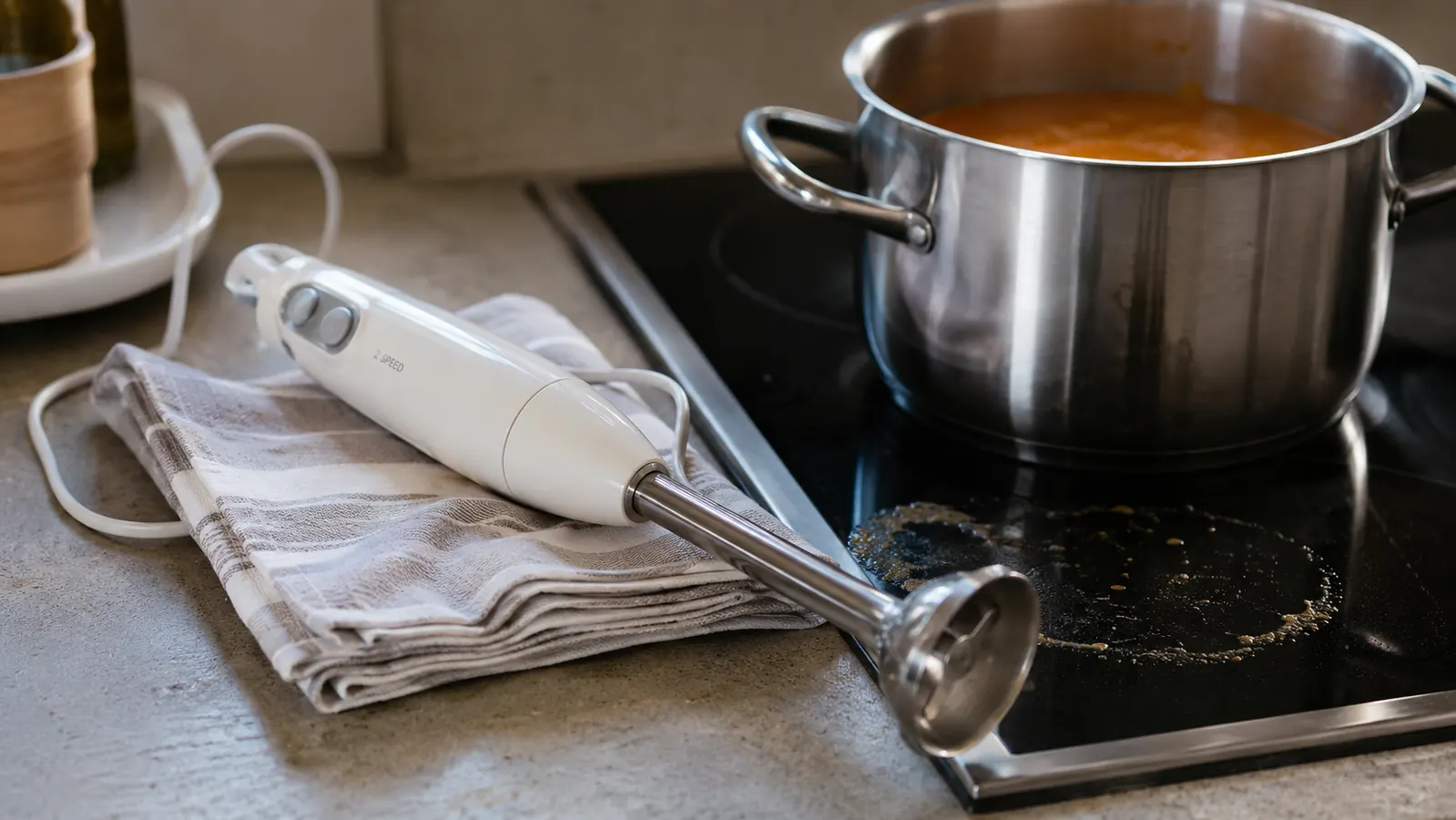
Nobody mentioned the splatter ring on my stovetop before I bought this. The first time I used the Cuisinart Smart Stick, I dropped it straight into a pot of thin tomato soup on high speed without thinking, and by the time I looked up there was a fine orange spray across the burner knobs and halfway up the backsplash. That's the kind of detail that never shows up in a glowing five-star review, and it's exactly the kind of thing I want to cover here.
I've had this Cuisinart blender in regular rotation for months now, through soups, gravies, sauces, and more than a few smoothies, and my opinion of it has settled somewhere between genuinely useful and honestly imperfect. That's a more useful review than a perfect score, so this is less a pitch and more a rundown of what actually happens when you own one, the good and the annoying parts both.
I'm not a professional cook and I don't pretend to be. I'm someone who cooks dinner from scratch most nights in a kitchen with about as much counter space as a normal apartment gives you, which means every tool I keep has to pull its weight or it gets sold or donated. This review runs on that standard, not restaurant standards.
The Quick Verdict
A solid, reliable stick blender that handles soups, sauces, and shakes well once you learn its quirks, but it has real limitations around splatter, noise, and hand fatigue that most reviews gloss over.
Amazon Check Today's Price →Before You Buy It, Know What You're Actually Getting
This isn't a miracle gadget, it's a genuinely handy tool with a learning curve. See today's price and current availability on Amazon before deciding if it's worth the counter space.
Amazon Check Today's Price on Amazon →How I've Used It
Most weeks this blender touches at least two meals. Corn chowder is my most repeated use, since it's a soup where I want most of it smooth with a few chunks of potato left for texture, and the Cuisinart immersion blender lets me control exactly how far I take it by just pulling it partway out of the pot when it looks right. I also lean on it for Thanksgiving gravy, where whisking out lumps by hand used to take longer than the gravy itself needed to reduce.
Protein shakes are the other regular use, mostly because I can blend one directly in a tall cup and drink from the same container, no extra dish. Homemade ranch dressing and a rough salsa verde round out the rotation, both jobs where a full countertop blender always felt like overkill for the amount I was making.
One small annoyance that took me a while to plan around is the cord length. It reaches comfortably from a standard countertop outlet to a pot on the front burner, but if the pot I want to blend is on a back burner, or my outlet happens to sit on the far wall, I've had to shuffle the pot closer or unplug something else nearby first. It's a minor thing, but it's exactly the kind of small friction that never comes up until you've actually lived with the tool for a while.
None of that is glamorous, but it's the honest use case, and it's why the blender has stayed out on the counter instead of migrating to a drawer. I compared how it actually stacks up against my old full-size blender for these same jobs in this side-by-side breakdown, since the tradeoffs are more specific than either tool is universally better.

The Splatter Problem Nobody Mentions
That opening story wasn't a one-time fluke. Splatter is the single biggest thing I wish someone had warned me about before I bought this, because the marketing photos always show a calm, controlled pot of soup, never the reality of what happens if you switch it on before the shaft is fully submerged. Thin liquids are the worst offenders. A watery vegetable soup or a loose gravy will jump the rim of the pot in a heartbeat if you start on high speed.
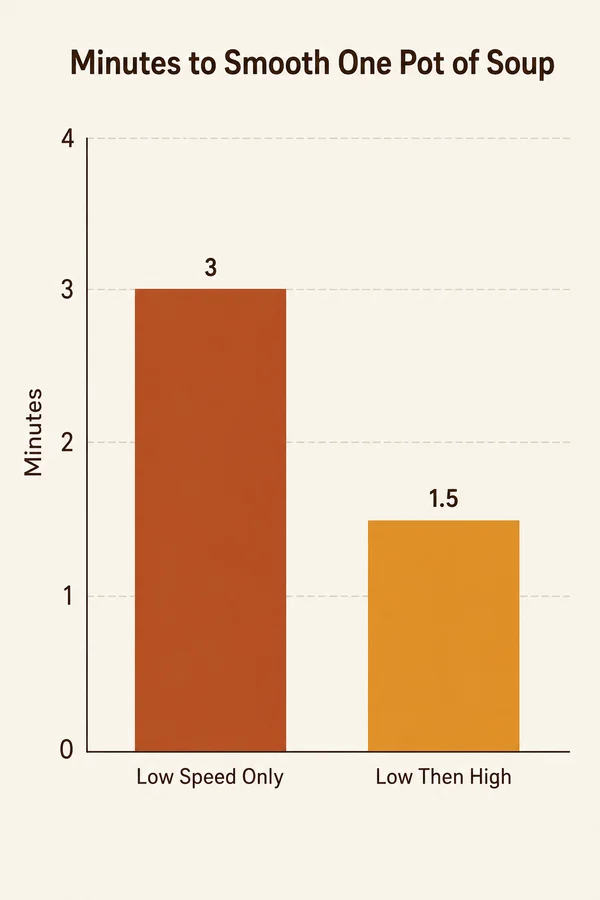
The fix is simple once you know it, start on the low speed with the shaft angled slightly and fully under the surface, then bring it up to high only once things have thickened a bit and stopped sloshing. I do this every single time now, and splatter is basically a non-issue. But it took two ruined stovetop cleanups and one splattered shirt to actually learn that lesson, and it's the kind of thing that should be on the first page of the instructions in bold letters, not buried where nobody reads it.
I've also learned to wear something I don't mind getting a few flecks on when I'm making soup now, which sounds small until you've ruined a decent shirt with tomato splatter on a random Tuesday. I keep a plain apron on a hook near the stove specifically for blending nights, which is a habit I never needed with the countertop blender since everything stayed contained inside the jar.
Deeper pots help too. I used to blend soup in a wide, shallow saute pan out of habit, and the shallow liquid level meant more surface area for splatter to escape from. Switching to a taller, narrower pot for anything I plan to blend cut the mess down noticeably, even before I fixed my speed habits.
The Motor: What 300 Watts Actually Feels Like
This runs a 300-watt motor, which sounds modest next to a countertop blender's numbers, but the way it's used changes what that rating actually means in practice. Because the blade is small and concentrated right at the tip of the shaft, that 300 watts gets applied to a narrow zone of liquid rather than spread across a wide jar, so it punches through soft, cooked vegetables faster than the wattage alone would suggest.
Where the motor's limits show up honestly is anything fibrous or uncooked. I tried blending raw carrots into a soup once, thinking the motor could handle what my knife skills couldn't be bothered with, and it strained audibly, working through the pieces slowly instead of cutting cleanly. Everything I blend now gets simmered soft first. That's not really a flaw, it's just not what this motor is built for, but it's worth knowing before you assume it can substitute for actual cooking prep.
Ice is the other honest weak spot. I've tried it on partially frozen fruit for shakes a few times and the motor bogs down noticeably, slowing to a labored churn instead of the smooth whir it has with soft food. I don't push it that hard anymore. If your shake habit depends on crushed ice every morning, this motor will make you wait for things to thaw first, which gets old fast.
It's also worth saying plainly what's in the box, because it's easy to assume otherwise from photos. This particular model is just the blending wand itself, no whisk attachment, no mini chopper bowl, nothing bundled beyond the blender and its cord. If you're picturing a full kit with extra attachments, that's not what arrives on your doorstep. For my use, straight blending is all I ever wanted, but it's the kind of detail worth knowing before you check out, not after.
Noise, Weight, and Hand Fatigue: The Unglamorous Stuff
Nobody reviews the noise level of a kitchen gadget, but you notice it every single time you use one in a house with a napping toddler or a partner on a work call in the next room. On high speed this blender is loud enough that conversation across the kitchen stops, closer to a garbage disposal than a quiet hum. It's not unusual for a motor this size, but if you're picturing something discreet, adjust that expectation.
Hand fatigue is real too, and it's the thing I underestimated most going in. Holding down the speed trigger continuously while also angling the shaft and steadying the pot with your other hand adds up over a full minute of blending a thick soup. My hand starts to ache faintly by the end of a big batch, especially on the high setting where the vibration is more pronounced. It's not a dealbreaker, but a single-serving smoothie feels effortless and a full pot of soup does not.
The unit itself is light, which mostly works in its favor since you're holding it the whole time, but that lightness also means the plastic housing feels a little hollow when you tap it, not flimsy exactly, just not the reassuring heft of a countertop appliance. It hasn't cracked or loosened on me, but if you're expecting something that feels dense and premium in the hand, this leans more toward practical than luxurious.
The speed trigger itself took a few uses to get comfortable with. It's stiffer than I expected the first week, enough that I second-guessed whether I was pressing it correctly, and it only loosened up slightly with regular use. It's not a problem exactly, more a small adjustment period that nobody mentions when they talk about how easy these are to use straight out of the box.
Where It Beats a Countertop Blender, and Where It Doesn't
The honest case for this tool is narrow and specific, not universal. It wins decisively on anything hot that you'd otherwise have to ladle into a blender jar in careful batches, and on anything small enough that dragging out a full-size blender feels like overkill for the dishes it creates. Gravy, a single smoothie, a small batch of dressing, these are exactly the jobs where the Cuisinart immersion blender is the obviously better tool.
It loses on volume and on anything that needs real power. A big pot of chowder for a dinner party takes noticeably longer to fully smooth out than the same amount would in a high-powered countertop blender, since you're working a narrow blending zone rather than a wide jar full of blades moving from every angle. I still keep my old countertop blender around for exactly those two situations, big batches and anything involving ice.
I also looked at a food processor as a possible substitute before settling on this, since I already owned one for chopping. It technically purees, but pouring hot soup into a food processor bowl carries the exact same splatter risk I was trying to solve, plus more parts to wash afterward. The narrower learning curve and easier cleanup of the immersion blender won out. I go into the full year-over-year picture of how the motor and blade guard have held up in this longer-term review, since durability is a separate question from day-one performance.
The question I get asked most is whether it's worth owning both, this and a countertop blender, or whether one should replace the other entirely. For me they cover different jobs well enough that neither feels redundant. The immersion blender takes over everything hot and everything single-serving, and the countertop blender stays reserved for the handful of times a month I actually need volume or crushed ice. If I had to keep only one, I'd keep this, simply because it covers more of my weekly cooking than the other one does.
What I Liked
- Genuinely useful for soups, gravies, sauces, and single-serving shakes
- Cleanup is just the shaft, no jar or gasket to hunt for in the dish rack
- Compact enough to hang on a hook, no counter space lost
- Two speeds make a real, learnable difference once you know the technique
- Handles hot liquid without the batch-transfer routine a countertop blender requires
Where It Falls Short
- Splatters badly if you start on high speed or skip a deep enough pot
- Loud on high speed, noticeable through the house
- Hand and wrist fatigue on longer blending sessions
- Struggles with ice, frozen fruit, and raw fibrous vegetables
- Large batches take longer than a proper countertop blender would
- No whisk or chopper attachment included, it's the blending wand only
It's not a miracle tool. It's a genuinely handy one that punishes you once for skipping the low-speed start, and then never lets you forget the lesson.

Who This Is For
If you regularly make soup, gravy, or a small batch of sauce or dressing and you're tired of transferring hot liquid into a countertop blender in careful stages, this solves that specific annoyance well. It's also a good match for anyone making single servings, one smoothie, one small sauce, where hauling out a full-size blender and washing its jar afterward has always felt disproportionate to the job.
It suits people willing to learn a small technique, the low-speed start, the deeper pot, in exchange for avoiding a much bigger daily annoyance. Once that habit clicks, the splatter issue mostly disappears and what's left is a tool that earns its spot quickly.
It's also a genuinely good fit for smaller kitchens where a second full-size appliance isn't realistic. A hook near the stove takes up none of the counter space a countertop blender demands, which matters more than it sounds like it would once you've actually tried to fit two bulky appliances on one stretch of counter.
Who Should Skip It
If your kitchen noise tolerance is already low, a napping baby, thin walls, a partner on calls all day, the loud high-speed setting is worth weighing seriously before buying. Anyone whose daily blending habit centers on ice or frozen fruit will spend more time fighting the motor than enjoying the convenience, and is better served by a blender actually built for that job.
It's also not worth adding if you already own a countertop blender you don't mind hauling out and washing, and hot-liquid transfer has never bothered you. This tool solves one specific friction point well. If that friction point was never really yours, you're buying a solution to a problem you don't have.
Know the Quirks, Still Worth It for the Right Kitchen
Once you know about the splatter, the noise, and the hand fatigue, the rest of this blender is genuinely solid. Check today's price on Amazon and see current availability.
Amazon Check Today's Price on Amazon →