
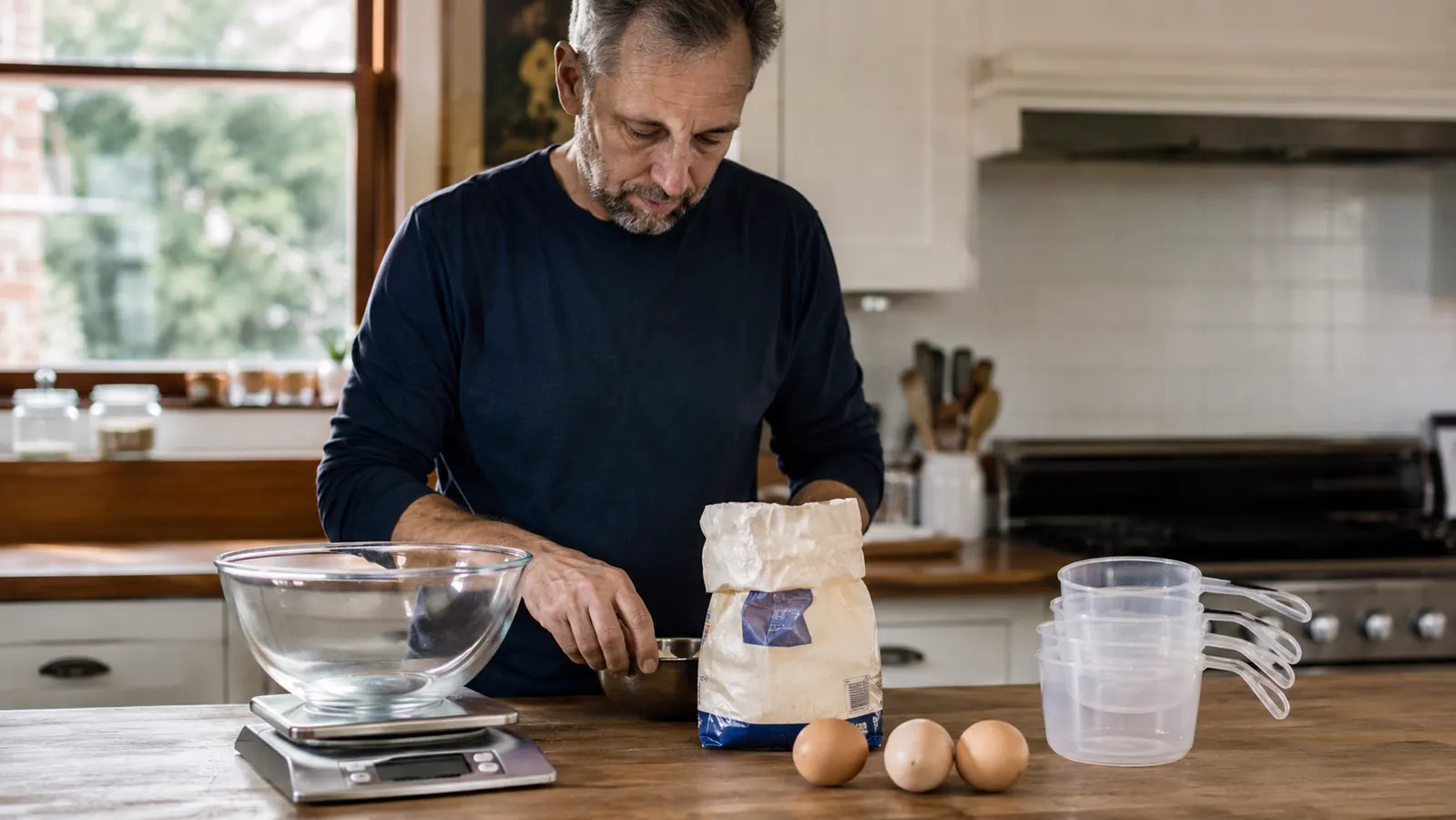
For years I baked with the same set of nested plastic measuring cups I got as a wedding gift, and I genuinely believed my banana bread just came out different every time because of humidity or my oven running hot. It wasn't the oven. When I finally bought an Etekcity digital kitchen scale and started weighing flour instead of scooping it, I watched my own "one cup" swing between 118 grams and 148 grams depending on whether I scooped straight from the bag or spooned it in first. That's not a small margin. That's the difference between a loaf that rises properly and one that turns out dense in the middle every single time.
So which one actually gives you better results, the Etekcity scale or the cups you already own? Short answer, for baking and anything where ratios matter, the scale wins clearly. For a quick pour of milk into a pan of scrambled eggs or a splash of broth into soup, the measuring cups are faster and perfectly fine. I'm not going to pretend the cups are useless just because I bought a scale, because I still reach for them constantly. But I want to walk through exactly where each one earns its keep, because too many comparisons like this pretend it's a total blowout in one direction, and that isn't honest.
| Etekcity Kitchen Scale | Measuring Cups | |
|---|---|---|
| Accuracy for baking (flour, sugar, cocoa) | Weighs to the gram, 120g of flour is 120g of flour no matter how it's scooped | Volume varies 10 to 20 percent depending on scoop technique, packing, and settling |
| Upfront cost | One-time purchase of a dedicated tool | Already sitting in most kitchen drawers, nothing new to buy |
| Speed for a quick liquid pour (milk, water, broth) | Requires taring the container and waiting a second for the display to settle | Grab the cup, pour to the line, done in seconds |
| Consistency across repeat batches | Identical weight every time, no interpretation involved | Depends on how firmly the ingredient is packed or leveled each time |
| Dependence on a power source | Runs on batteries, a dead battery means no reading until it's replaced | Nothing to charge or replace, works exactly the same forever |
| Scaling a recipe up or down | Multiply the gram number, weight scales predictably at any size | Fractional cups (a third, two-thirds) get harder to measure accurately as portions shrink |
| Dishwashing and cleanup | One bowl sits on the platform, ingredients added directly, screen wipes clean | A separate cup or spoon for every ingredient adds to the sink pile |
| Fine for casual, non-baking cooking | An extra step for something that doesn't actually need gram-level precision | Fast, familiar, and good enough for eyeballed soups, sauces, and skillet meals |
| Works for both dry and liquid ingredients | Handles both equally well by weight, one tool for everything | Also handles both, just with separate dry cups and a liquid measuring cup |
Where the Etekcity Scale Wins
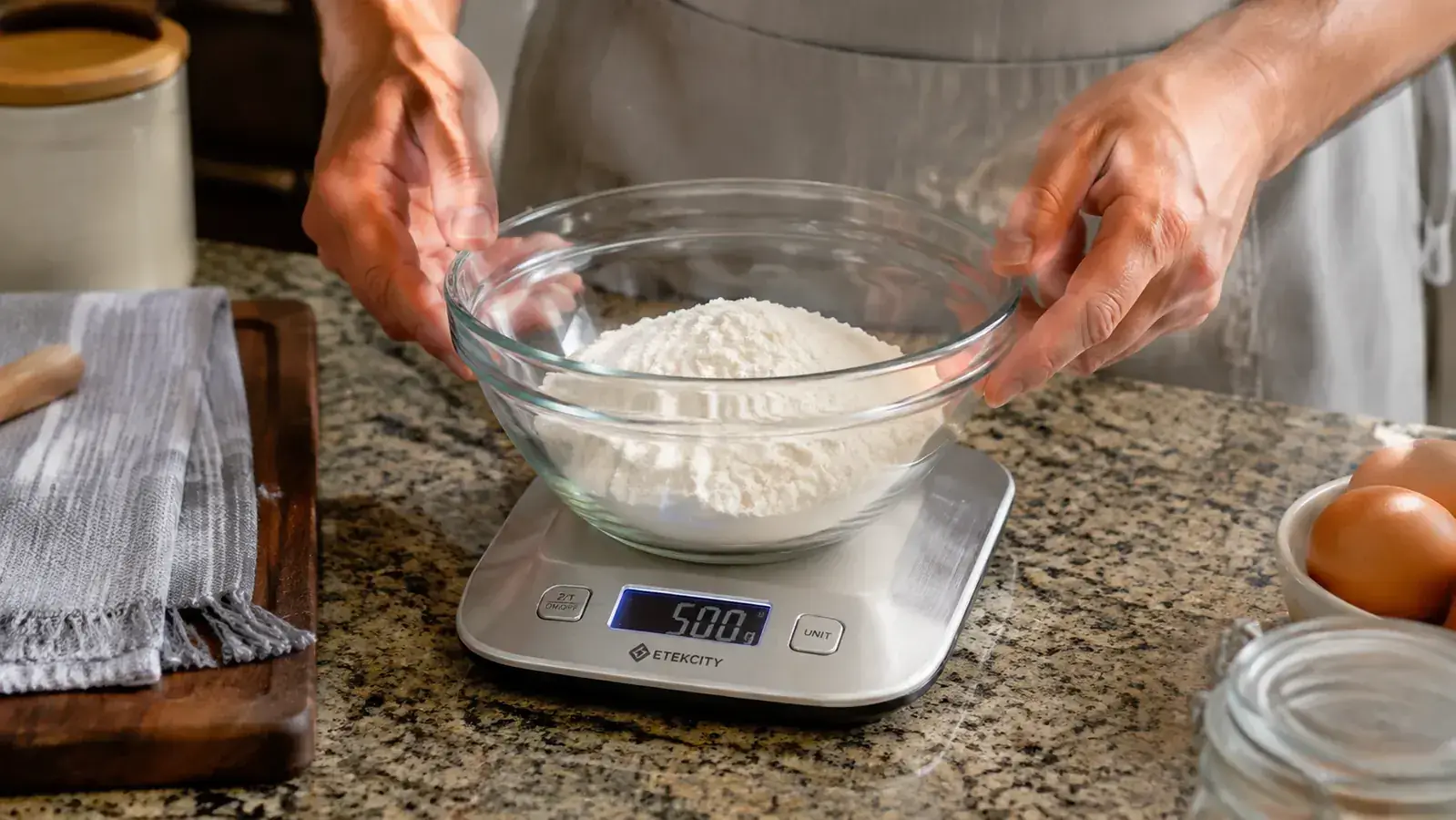
Baking is the obvious one, but the reason it matters is worth spelling out. Flour compacts in the bag over time, so a scoop from a freshly opened bag and a scoop from one that's been sitting in the pantry for a month can weigh noticeably different amounts even though they fill the same cup. A scale skips that problem entirely because it doesn't care how the flour got into the bowl, it only reports what's actually there. Since I switched, my banana bread rises the same way every time, and I stopped blaming my oven for something that was actually a measuring cup problem the whole time.
The second place it wins is scaling recipes, which sounds minor until you try to measure two-thirds of a cup of brown sugar by eye three times in a row and get three slightly different amounts. On the Etekcity scale, doubling a recipe just means doubling the gram number on the screen, no fractional guesswork, no wondering if I packed it the same way as last time. I use this constantly when I'm making a double batch of cookies to freeze half, since even a ten percent sugar difference between batches is noticeable once they're baked side by side.
Cleanup is the quieter win, and it's the reason the Etekcity scale stays out on my counter instead of getting put away after every use. I set the mixing bowl right on the platform, tare it to zero, and add each dry ingredient straight into the same bowl I'm already mixing in. There's no cup to wash for flour, another for sugar, another for cocoa powder. When I'm done, it's one bowl and a stainless steel platform that wipes down with a damp cloth. Compare that to a baking session with cups, where I'm usually digging through a drawer for the right size mid-recipe because the one I need is still in the dishwasher.
Where Measuring Cups Win
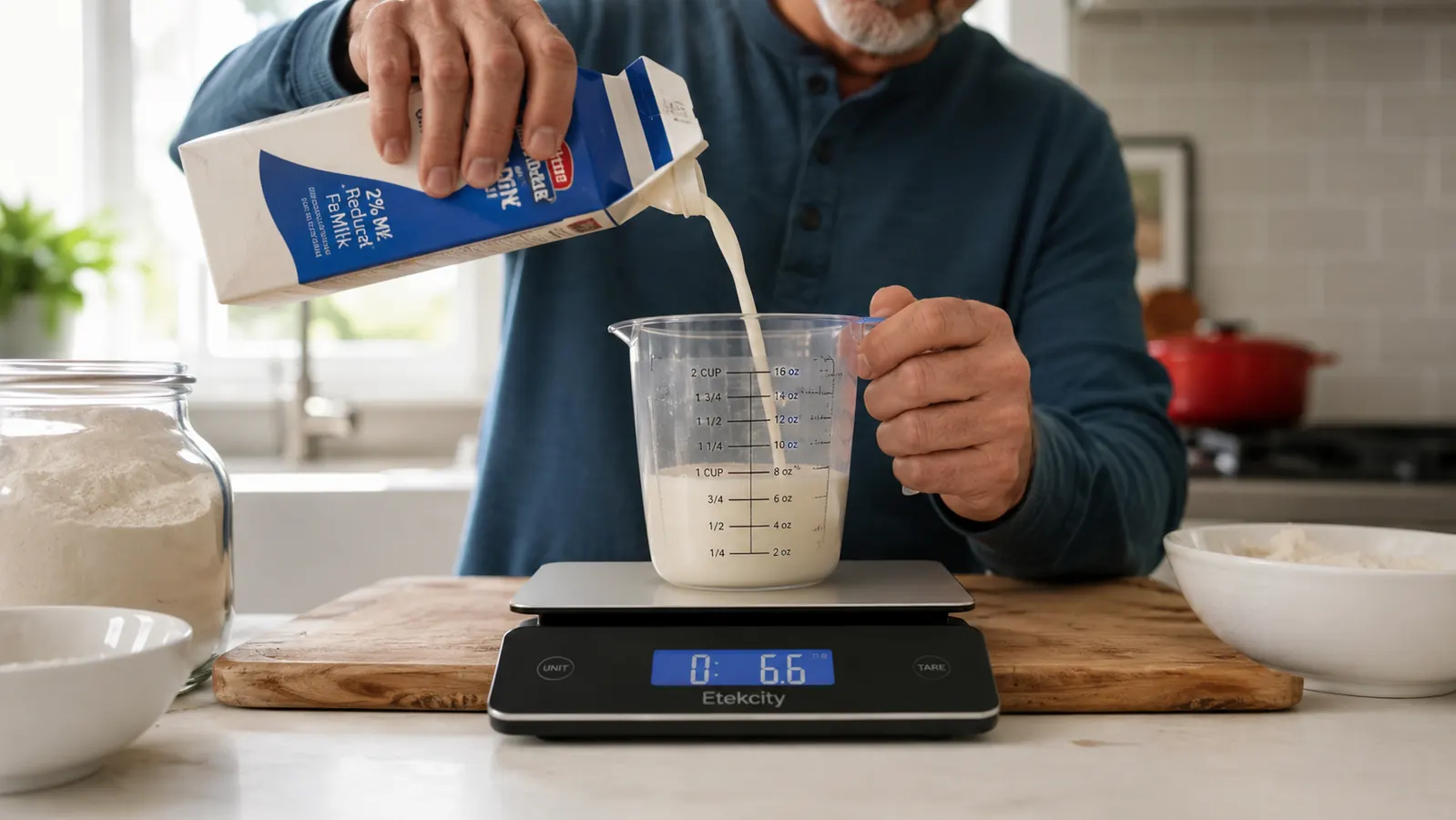
I'll say this plainly because it would be dishonest not to: for a quick splash of milk into scrambled eggs or a cup of broth into a pot of soup, measuring cups are faster and I still reach for them without thinking twice. Pouring liquid to a line on a cup takes about three seconds. Getting the same reading on a scale means grabbing a container, setting it on the platform, taring it to zero, and pouring slowly while watching the number climb. For casual, non-baking cooking where being off by a tablespoon changes nothing about how the dish turns out, that extra step is friction I don't need.
Cups also win on the most basic thing a tool can win on, which is that everyone already has them and they never break. There's no battery to die at the worst possible moment, no display to stop responding, nothing that needs a firmware update or an app connection. If the power goes out or the battery dies mid-recipe, which has actually happened to me on a scale before, a set of plastic measuring cups doesn't care. That kind of reliability is easy to take for granted until the one time your scale doesn't turn on and you're standing there holding a bag of flour with nowhere to put it.
There's also a comfort factor that I don't think gets enough credit. Most people learned to cook using cups and spoons, so the mental math of "a cup of flour, a teaspoon of salt" is second nature in a way that gram amounts on a screen simply aren't yet, even after using a scale for a while. If you're cooking from an old family recipe card written in cups, converting it to weight adds a step that some cooks genuinely don't want to bother with, and that's a fair reason to stick with what you've got for everyday meals.
If your baking results have ever felt inconsistent for no reason you could explain, the scoop was probably the reason.
Weighing flour and sugar instead of scooping them removes the single biggest source of baking variation in a home kitchen. Check today's price on Amazon.
Amazon Check Today's Price on Amazon →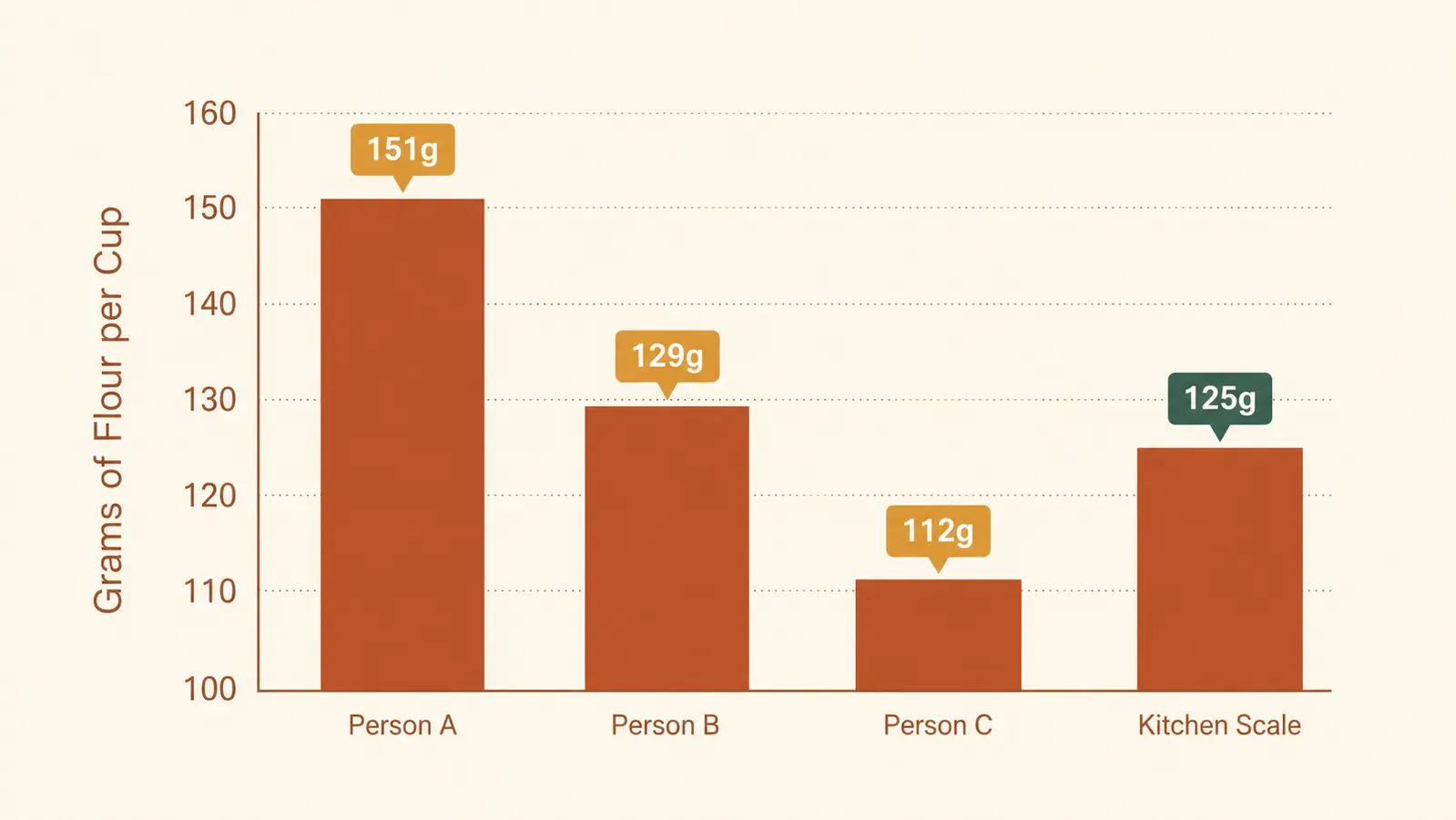
The Real Difference: Weight Versus Volume
Once you stop thinking of this as scale versus cups and start thinking about what each one is actually measuring, the choice gets a lot clearer. A cup measures volume, meaning how much space an ingredient takes up, which changes depending on how it's packed, how humid the air is, and how fine or coarse the particles are. A scale measures mass, meaning the actual amount of stuff you have, which doesn't change no matter how it's sitting in the bowl. For ingredients like water or milk, volume and weight track together closely enough that it barely matters which one you use. For ingredients like flour, brown sugar, or shredded cheese, the two can drift apart by a lot, and that drift is exactly where baking recipes start failing for reasons that feel mysterious.
That's really the whole story here. Recipes that depend on ratios holding steady, mostly baking, benefit from weight because weight doesn't lie about how much you actually have. Recipes that are forgiving by nature, most everyday savory cooking, don't need that level of precision and a cup gets the job done just as well with less fuss. If your cooking is split between the two, and most home cooks' is, the honest answer is that you probably want both tools in the kitchen rather than picking a side.
Consistency Nobody Talks About Until a Cake Fails
The thing that finally sold me on the scale wasn't a single dramatic failure, it was noticing that the same recipe kept turning out slightly different every time I made it, and I couldn't figure out why. I was following the recipe exactly. I was using the same oven, the same pan, the same brand of flour. What I wasn't doing was scooping the same amount of flour every time, because nobody scoops with perfect consistency by hand, not even after years of practice. A scale removes that variable completely, which means when a recipe doesn't turn out right, I actually know it's the recipe or the technique and not the measuring.
This matters even more if you're trying to replicate someone else's recipe exactly, whether that's a professional baker's blog or your grandmother's handwritten card that lists everything in grams because that's how she learned to cook. Volume measurements assume a shared, consistent scooping technique that honestly doesn't exist between two different people, or even between you on a Tuesday and you on a Sunday. Weight measurements remove the guessing entirely, and once you've baked the same recipe both ways and compared the results side by side, it's hard to unsee the difference.
My measuring cups never once told me my recipe was wrong. My scale did, and it turned out my recipe was fine. It was my scooping that wasn't.
Who Should Buy Which
If you bake with any regularity, bread, cookies, cakes, anything where the ratio of flour to liquid to leavening actually determines whether it works, get the scale and use it as your default for dry ingredients. It's also worth it if you've ever wondered why the same recipe comes out differently every time you make it, or if you're trying to follow recipes written by someone who measures in grams. The learning curve is small, mostly just remembering to tare the bowl before adding each ingredient, and our portioning guide walks through the exact routine I use for both baking and everyday meal prep.
Stick with measuring cups, or keep using them alongside a scale, for quick everyday cooking where a little variation doesn't change the outcome, soups, sauces, marinades, anything you're seasoning to taste anyway. They're also the right call if you're cooking from recipes that were written in cups and you don't want to bother converting them, or if you just want a backup that never needs batteries. The two tools aren't really in competition once you see it this way. I keep both in my kitchen, but if I had to give up one, the cups would go first, because the scale is the one that actually fixed something that was wrong with my cooking for years.
Stop guessing why the same recipe turns out different every time.
A digital scale removes the one variable that scooping can never control. If baking consistency matters to you, this is the upgrade that actually solves it. Check today's price on Amazon.
Amazon Check Today's Price on Amazon →